



When a term life insurance policy expires, the level premium period ends and the death benefit stops unless you take one of a few specific steps. Standard term policies don’t refund anything, and staying covered almost always costs more than you paid before.
Quick answer: When term life insurance expires, your coverage ends and you get no money back unless you bought a return of premium policy. You can usually convert to permanent coverage without a medical exam, keep the policy at sharply higher yearly rates, apply for a new policy, or let it go if no one depends on your income anymore.
What Happens When Term Life Insurance Expires
A term policy has a level period, usually 10, 20, or 30 years, during which the premium and death benefit stay fixed. When that period ends, the price guarantee ends with it. What happens next depends on your contract: some policies simply stop, while most let you keep coverage at a new, much higher rate that rises every year.
It helps to separate two moments that people often call “expiration”:
| Moment | What happens | What you can still do |
| End of the level term | Locked-in premium ends; coverage stops or switches to yearly renewable pricing | Convert, renew at the new rate, replace, or let it end |
| Final expiration age | The contract can no longer be renewed at any price | Only a new policy, if you can qualify |
| Conversion deadline | The right to convert without new health questions ends | Nothing; the conversion option is gone for good |
State Farm, for example, describes its term coverage as guaranteed renewable to age 95, but warns that renewal premiums “will increase significantly every policy anniversary and will likely become unaffordable.” USAA notes that the final expiration age on most term policies falls in the 80s or 90s. That’s later than many people assume, but the price of staying covered that long is the real limit.
Note: The conversion deadline is often earlier than the end of the term. Some contracts allow conversion only during the level period, and others cut it off at a set age. Check the conversion section of your policy now, not in the final month.
What happens if you outlive your term life insurance
Outliving your policy means the coverage did its job. You paid to protect your family during the years they needed your income most, and you’re still here. That’s the outcome every policyholder hopes for, even though the policy pays nothing.
The practical question is whether anyone still depends on you. If your mortgage is paid off, your children support themselves, and your spouse would be secure on savings and retirement income, letting the policy end can be a sensible choice. If you still carry debt, support a spouse with little retirement income, or want money set aside for funeral costs, you’ll want to act before the term ends.
Do you get money back when term life insurance expires
No, not with a standard policy. A term policy pays a death benefit only if you die during the coverage period. If you outlive it, the insurer keeps the premiums, the same way a car insurer keeps your premium in a year you have no accident. The one exception is a return of premium policy, covered in the next section.
Where the Money Goes When Term Life Insurance Expires
Your term premiums pay for one thing: the insurer’s promise to pay your beneficiaries if you die during the term. That’s why term costs a fraction of permanent coverage, and it’s also why nothing is left when the term ends.
Why standard term life insurance has no cash value
Insurers price term policies by pooling risk across many policyholders. Each premium covers the expected cost of claims for the group, plus the insurer’s expenses. Because most people outlive their term, the premiums of those who survive help fund the claims of those who don’t. No portion of your premium is set aside in an account for you, so a standard term policy has no cash value to withdraw, borrow against, or surrender.
Compare that with whole life insurance, where part of each premium builds a guaranteed cash value. That savings feature is the main reason whole life costs many times more than term for the same death benefit. Our guide to term vs. permanent life insurance covers that trade-off in detail.
Return of premium term life insurance
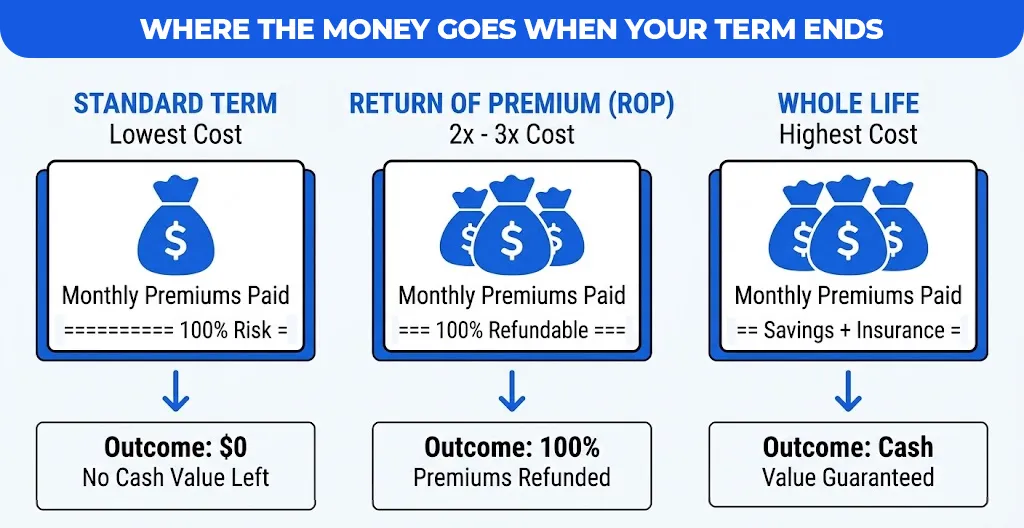
A return of premium (ROP) policy, or a standard policy with an ROP rider, refunds the premiums you paid if you outlive the term. Policygenius reports that this feature typically costs two to three times as much as standard term, and that the refund generally isn’t taxable because it’s a return of money you already paid.
Here’s what that looks like for the 40-year-old man in the rate examples later in this guide. These ROP figures are hypothetical, built from the 2x to 3x range, not quotes.
Standard 20-year term, $250,000, male age 40: $17/month
Total paid over 20 years: $4,080, nothing back
Hypothetical ROP version at 2x to 3x: $34 to $51/month
Total paid over 20 years: $8,160 to $12,240
Refunded at age 60 if still alive: $8,160 to $12,240
The refund sounds appealing, but you’d be prepaying an extra $17 to $34 a month for 20 years with no interest. ROP also tends to punish early cancellation: many policies pay a partial refund or nothing if you drop coverage before the term ends, so check the refund schedule before buying.
Term life insurance maturity vs. expiration
These words sound alike but mean different things. A term policy expires: coverage ends and, unless you have ROP, nothing is paid. A permanent policy matures: when the insured reaches the maturity age set in the contract, often 100 or 121, the insurer typically pays out the cash value or the face amount. You’ll see “maturity” in whole life and universal life contracts, not standard term.
| Feature | Standard term | Return of premium term | Whole life |
| Relative cost | Lowest | About 2x to 3x standard term | Many times standard term |
| Cash value | None | None you can borrow during the term | Builds on a guaranteed schedule |
| What happens at the end | Coverage ends, nothing paid | Premiums refunded if you outlive the term | No end date; matures at a set age |
| Cancel early | Coverage stops, no refund | Partial or no refund in many policies | Receive the cash surrender value |
| Best fit | Covering a set number of years at the lowest cost | Savers who want a guaranteed refund and can afford the premium | Lifelong coverage and forced savings |
The Four Options When Your Term Life Insurance Expires
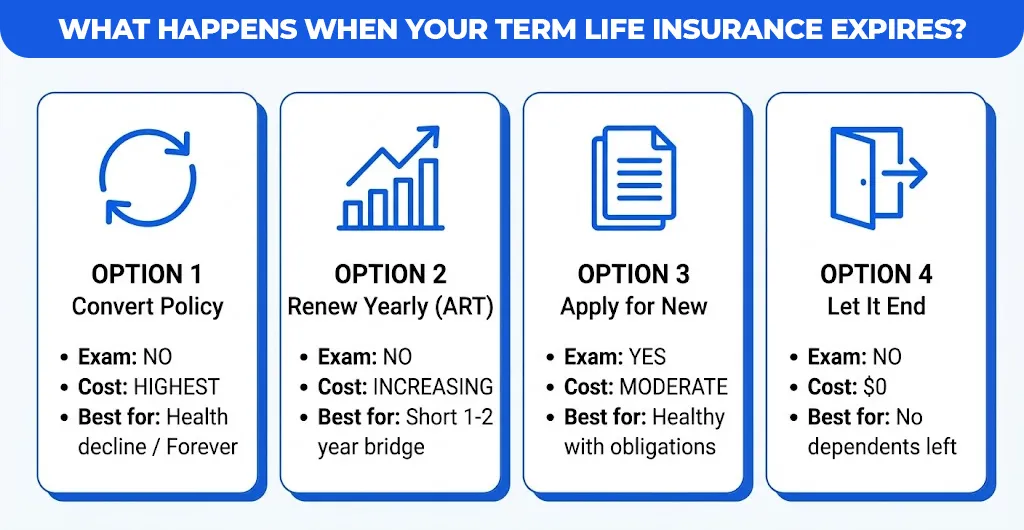
When your term ends, you can convert it, renew it at yearly rates, replace it with a new policy, or let it end. Each choice trades cost against health risk differently, and the right one depends mostly on two things: how much coverage you still need and how healthy you are today.
Option 1: Convert to permanent life insurance
Most term policies include a conversion privilege that lets you exchange some or all of your term coverage for a permanent policy from the same insurer. USAA notes that conversion doesn’t require a new medical exam. That makes it the most valuable option for anyone whose health has declined since buying the policy.
The catch is cost. The new premium is based on your age at conversion, and permanent coverage is expensive at 55 or 60. For a $250,000 policy at age 60, published 2026 whole life sample rates run about $664 a month for women and $761 for men. Two ways to reduce that:
• Partial conversion: If your contract allows it, convert only the amount you need for lifelong goals, such as final expenses or a small inheritance, and let the rest expire.
• Product choice: Some insurers let you convert into guaranteed universal life insurance, which usually costs less than whole life because it builds little or no cash value.
Note: Conversion windows close. Many contracts only allow conversion before a set age or before the level term ends. Once that date passes, the no-exam option is gone even if the policy is still renewable.
Option 2: Keep it going with annual renewable term
If you do nothing, many policies roll into annual renewable term (ART). Coverage continues, but the premium resets each year based on your current age, and the first jump is usually the biggest. Financial writer Hans Goldstein published a real renewal example from a Pacific Life policy:
Sample policy: $250,000 term, male issued at age 45
Level premium, years 1 to 20: $372 per year
Renewal premium, year 21: $10,210 per year
Increase: about 27 times the original premium
The premium keeps climbing every year after that. The same article cites Society of Actuaries research finding that lapse rates reach about 93% when premiums jump 18 to 20 times. In practice, almost everyone who faces that bill drops the policy. ART makes sense for a short bridge, such as covering a year or two while you finish paying a debt or wait for a new policy to be approved. It rarely makes sense as a long-term plan.
Option 3: Apply for a new life insurance policy
If you’re still in good health, a new term policy is often far cheaper than either converting or renewing. You’ll go through underwriting again, which may include a health questionnaire, prescription check, and possibly an exam, and your rate will reflect your current age and health. For people in their 50s and 60s, a shorter term often fits best because the remaining obligations, like a mortgage or a spouse’s years until retirement, are shorter too. Our guide to term life insurance for seniors covers what carriers look for at older ages.
The one rule that matters here: don’t let the old policy end until the new one is approved and in force.
Option 4: Let the coverage end
If nobody would struggle financially without your income, you may not need life insurance anymore. This is sometimes called self-insuring: your savings, home equity, and retirement income would cover your family’s needs. Some people still keep a small policy for funeral costs, which a final expense life insurance policy can cover with simplified underwriting.
| Option | Medical exam? | Cost compared with the original premium | Best fit |
| Convert | No | Highest monthly cost, but stays level for life | Health has declined, or you need lifelong coverage |
| Renew yearly (ART) | No | Often many times higher, and rises every year | Short bridge of a year or two |
| New policy | Usually yes | Several times higher, but far below ART | Healthy and still has obligations |
| Let it end | No | Zero | Debts paid, dependents independent, savings in place |
What Happens When 20-Year Term Life Insurance Expires
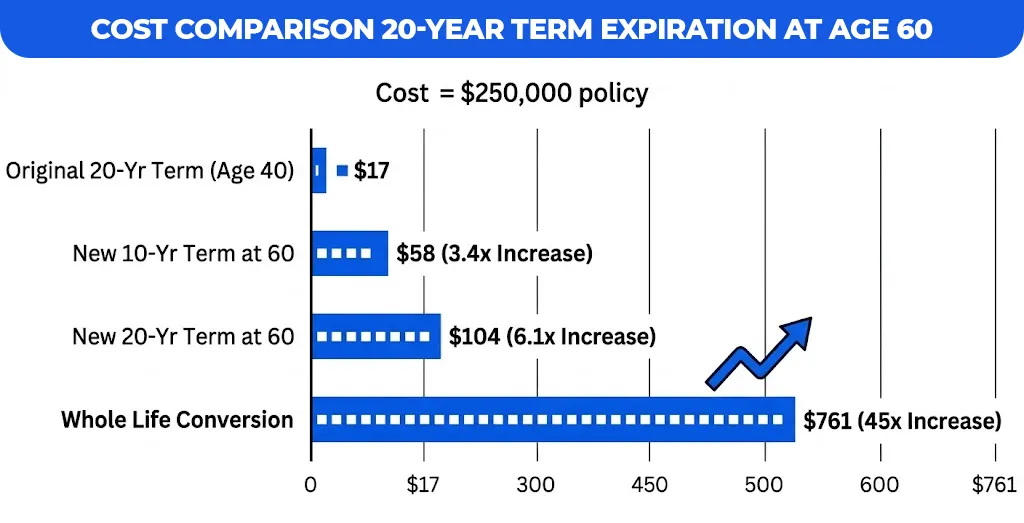
A 20-year policy is the most common term length, and it typically ends in your mid-50s or early 60s. At that point your coverage either stops or switches to yearly renewal pricing, and replacing it costs several times your original premium. The two scenarios below use Choice Mutual sample rates for preferred, non-tobacco applicants, valid as of March 9, 2026.
Scenario 1: Bought at 40, expires at 60
A 40-year-old buys $250,000 of 20-year term. At 60, the policy ends and they need to decide what to do.
| Choice at 60 | Women, monthly | Men, monthly | Change for men vs. original |
| Original 20-year term bought at 40 | $15 | $17 | Baseline |
| New 10-year term at 60 | $39 | $58 | About 3.4x |
| New 20-year term at 60 | $73 | $104 | About 6.1x |
| Whole life at 60 (conversion cost proxy) | $664 | $761 | About 45x |
| Yearly renewal (ART) | Varies by carrier | Varies by carrier | The Goldstein example was about 27x |
The whole life row uses new-purchase rates as a rough guide. Your actual conversion quote comes from your insurer and depends on the products it offers for conversion.
Scenario 2: Bought at 35, expires at 55
A 35-year-old buys $500,000 of 20-year term. At 55, the policy ends.
| Choice at 55 | Women, monthly | Men, monthly |
| Original 20-year term bought at 35 | $17 | $20 |
| New 10-year term at 55 | $49 | $66 |
| New 20-year term at 55 | $82 | $112 |
| Whole life at 55 (conversion cost proxy) | $1,006 | $1,152 |
The pattern holds in both cases. A new term policy costs roughly three to six times the original premium, while permanent coverage costs about 45 to 60 times as much. That gap is why healthy people usually replace with new term, and why conversion is mostly worth it for people who can’t qualify anymore.
Note: These are published sample rates for the healthiest rate class. Smokers and people with health conditions will pay more, and some may not qualify for new coverage at all, which is exactly when conversion becomes valuable.
What about 10-year and 30-year terms
The same math applies to other term lengths. A 50-year-old who buys $250,000 of 10-year term pays about $20 a month for women or $23 for men, and lands at 60 facing the same replacement prices as Scenario 1. A 30-year-old who buys 30-year term at $15 or $18 a month also reaches 60, but has had the lowest price locked in for three decades.
Life changes to check before you choose
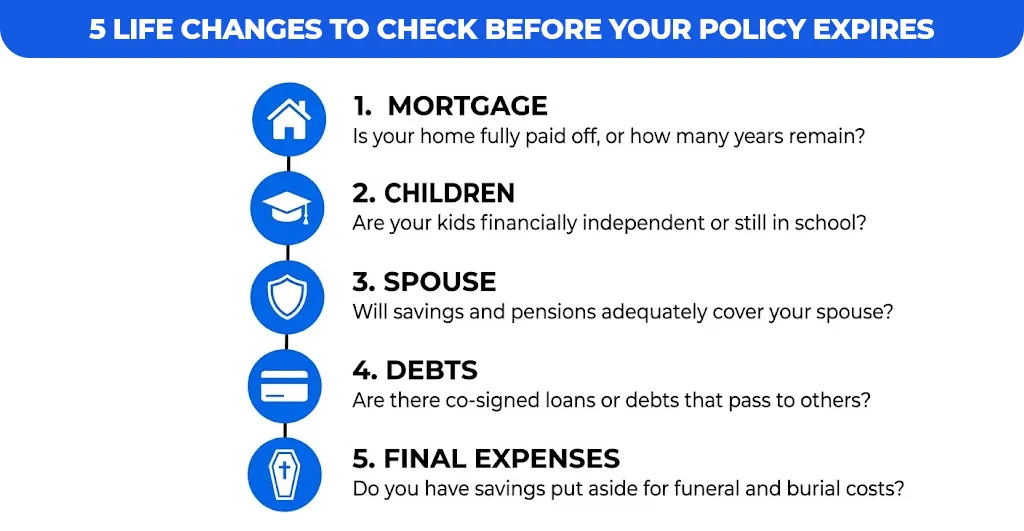
By 55 or 60, many of the reasons you bought term have changed. Before picking an option, look at:
• Mortgage: Is it paid off, or how many years remain?
• Children: Are they financially independent, or still in college?
• Spouse or partner: Would they have enough income from savings, pensions, and Social Security?
• Other debts: Car loans, co-signed loans, or business debts that would pass to someone else.
• Final expenses: Funeral and burial costs your family would need to cover.
If most of these are settled, you may need far less coverage than before, or none. If several are still open, plan to keep some coverage in place.
How to Replace or Convert an Expiring Policy With Assurance Gurus
The best time to plan is 6 to 12 months before your term ends. That gives you time to check your conversion deadline, apply for new coverage while you still have the old policy as a backup, and compare prices across carriers instead of accepting the renewal notice.
Step 1: Find your expiration date and conversion deadline
Pull out your policy contract or call your insurer and ask three questions:
• On what date does the level premium period end?
• Until what date or age can I convert, and which products can I convert into?
• What will my premium be in the first year after the level period ends?
Write the conversion deadline down separately. It’s the one date you can’t recover if you miss it.
Step 2: Recalculate how much coverage you still need
Your needs at 55 or 60 are rarely the same as when you bought the policy. Add up what your family would need if you died this year:
• Remaining mortgage balance and other debts
• Years of income your spouse or partner would need to replace
• Remaining college costs, if any
• Funeral and final expenses
Subtract the savings, investments, and other coverage your family could use. The Assurance Gurus life insurance calculator can help you estimate the gap. Many people find they need a fraction of their original face amount, which cuts the cost of any new policy.
Step 3: Compare carriers, not just your current insurer
Your current insurer’s renewal or conversion offer is only one price. If you’re healthy, other carriers may offer a new term policy for much less. An independent agency can compare several carriers at once and tell you which ones are more lenient with the health conditions you have. You can start with term life insurance quotes or, for lifelong coverage, whole life insurance quotes.
Step 4: Apply before your coverage ends
If you’re replacing, apply early enough that underwriting finishes before your old policy expires. Keep the old policy in force until the new one is approved, issued, and paid for. If the new application is declined, you can still fall back on conversion as long as the deadline hasn’t passed.
Step 5: Decide on any leftover coverage
Once the new coverage is in place, choose what to do with the old policy: let it expire, convert a small part for permanent needs, or cancel it. Don’t cancel anything until you’ve confirmed the replacement in writing.
Note: If you’re thinking about lifelong coverage, compare the real cost first. Our breakdowns of whole life insurance cost and whether whole life insurance is worth it explain when permanent coverage pays off and when it doesn’t.
Conclusion
What happens when term life insurance expires comes down to a simple fact: the coverage ends, your premiums aren’t refunded, and staying insured costs more than before. The decision is which way of paying more, if any, fits your situation. Healthy people with remaining obligations usually do best with a new, shorter term policy. People whose health has changed should look hard at conversion before the deadline. And people whose dependents are secure may not need coverage at all.
| Your situation | Option to look at first |
| Healthy, mortgage or dependents still to cover | New term policy sized to the remaining years |
| Health has declined since you bought the policy | Convert before the deadline, possibly only part of it |
| Need coverage for a year or two only | Short-term renewal, then let it end |
| Want lifelong coverage for final expenses | Partial conversion or a final expense policy |
| Debts paid, dependents independent, savings in place | Let the policy end |
| Not sure how much you still need | Run a needs calculation before choosing anything |
Review Your Expiring Term Policy With Assurance Gurus
If your term ends in the next year or two, now is the time to compare your options while every door is still open. You can audit your expiring term policy with Assurance Gurus: share your current coverage, end date, and health details, and a licensed agent will help you compare replacement term quotes from several carriers against your insurer’s renewal and conversion offers.
• Request a quote: Get replacement term quotes on Assurance Gurus
• Estimate your needs: Use the life insurance calculator
• Call: 888-363-1938